Carbon occurs in graphite, diamond and living things.
A pencil and a diamond: the same element?
Graphite, used in pencil cores, is black and has layers that can slip and flake away. Diamond is transparent and exceptionally hard, so it can be used to cut other materials. Both are made of carbon atoms.
The difference comes from how the atoms connect. Different forms of the same element are called allotropes. Carbon gives us a striking example: changing the arrangement changes the material.
Same element, different structures
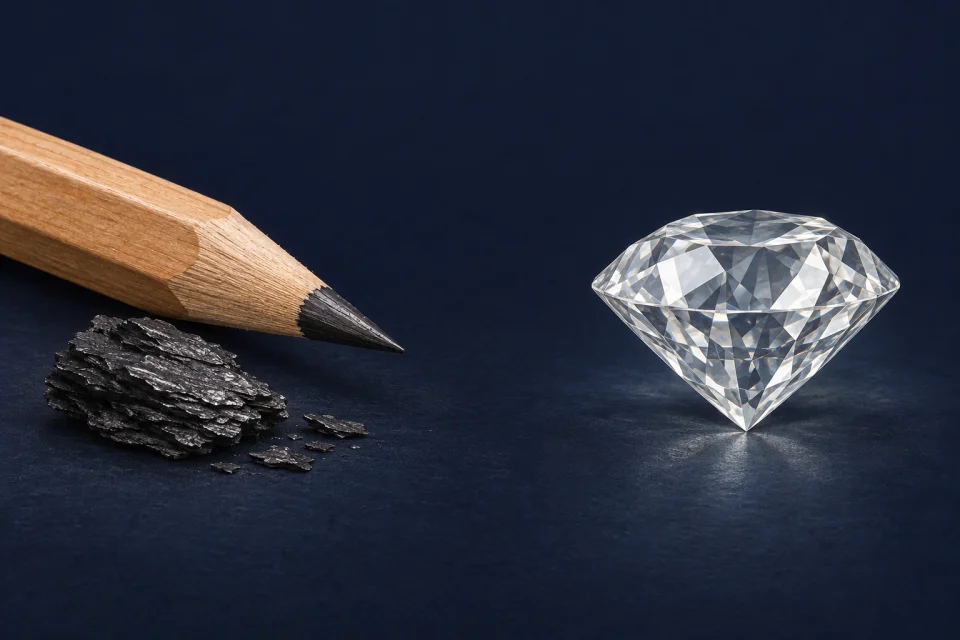
GraphiteDiamond
Both are forms of carbon. Their atomic structures give them different properties. Pencil cores also contain clay and other ingredients.Structure changes what a material can do
In graphite, carbon atoms form hexagonal networks stacked in layers. The layers can move relative to one another more easily than atoms can separate within a layer. Rubbing graphite on paper leaves tiny flakes behind; clay and other ingredients help adjust a pencil core.
In diamond, each carbon atom bonds to four others in a three-dimensional network. This connected structure helps explain its hardness. An element name alone does not tell us every property of a material.
Graphite: stacked network layers
Diamond: four neighbors in a 3D network
Only part of each structure is shown. Dots represent atoms and lines represent bonds. Sizes and spacing are schematic.
Schematic diagram based on reference sourcesWhat burning a diamond revealed
It was not obvious that black carbon and a clear diamond could be forms of the same element. Experiments heating diamonds showed that reacting them with oxygen produces carbon dioxide. That helped establish their identity as carbon.
The lesson is a scientific one: appearance is not enough. Investigating what reacts and what products form can reveal what a material is made of. Even a diamond is a substance that can undergo chemical change.
Carbon connects air, plants and living things
Carbon is not only found in pure forms such as graphite and diamond. It combines with other elements in carbon dioxide, sugars and proteins. Carbon atoms can form chains and branching structures, providing a framework for many different substances.
Plants take in carbon from carbon dioxide through photosynthesis. Carbon can then move through food to other organisms, while respiration returns some of it as carbon dioxide. The atoms are changing their surroundings and combinations, rather than disappearing.
CO₂ in air→Plants→Food & organisms
Photosynthesis takes carbon in; respiration returns it (a simplified selection of pathways)Temperature and state
25°C: Solid
Illustrative particle motion: sizes, distances and speeds are not to scale. Particles represent atoms or molecules.
← CoolHeat →
Sublimation (approx.) 3,825°C
Approximate value for graphite. At 1 atmosphere it sublimes without a liquid phase.
Pure element at 1 atmosphere. Image conditions are explained in captions. Pictures do not change with temperature.