A metal that is part of table salt
Elemental sodium is a soft, silvery metal. It reacts readily with air and water, so we rarely encounter it as an everyday material. Yet the white salt in a kitchen contains sodium.
Salt does not contain little pieces of sodium metal. It is a compound made of sodium ions and chloride ions. The same element can be present in substances with very different properties.
Salt is different from its elements
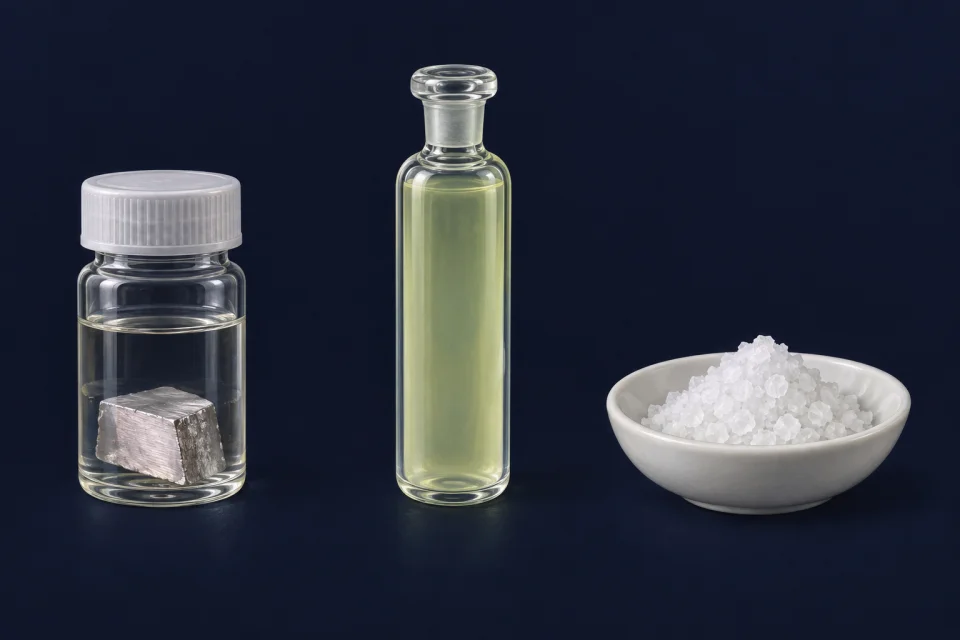
SodiumChlorineSalt
Sodium metal, chlorine gas and table salt have different properties. Salt is a compound containing sodium and chlorine.Changing electron count creates an ion
An ion is an atom or group of atoms with an electric charge. Losing one electron makes a sodium atom a positive sodium ion, Na⁺. Gaining one electron makes a chlorine atom a negative chloride ion, Cl⁻.
In a salt crystal these ions form an ordered three-dimensional arrangement, held together by attraction between opposite charges. NaCl gives a one-to-one ratio. It does not mean that the whole crystal is a single pair of atoms.
Sodium ions (Na⁺) and chloride ions (Cl⁻) form a regular crystal.
A flat section is shown; the real structure extends in three dimensions. This is not an experimental procedure.
Schematic diagram based on reference sourcesDissolving does not make the ions disappear
When salt dissolves, the white crystal is no longer visible. Its ions separate into the water and become surrounded by water molecules. The sodium and chlorine from the salt have not disappeared.
Dissolving and melting are different processes. Dissolving disperses a substance into a solvent; melting turns a solid into its liquid state. The temperature control below concerns elemental sodium, not salt water.
Temperature and state
25°C: Solid
Illustrative particle motion: sizes, distances and speeds are not to scale. Particles represent atoms or molecules.
← CoolHeat →
Melting point 97.8°C / Boiling point 882.85°C
Pure element at 1 atmosphere. Image conditions are explained in captions. Pictures do not change with temperature.