Copper conducts electricity well and can be drawn into wires.
Why copper is inside a wire
A wire has different parts with different jobs. Its outer insulation is made from material that does not conduct electricity well. Inside are metal conductors, often made of copper. Copper has a reddish color, unlike the silver-gray appearance of many metals.
Copper conducts electricity well and can be drawn into thin wires. The conductor carries current; the insulation separates it from its surroundings. Understanding the whole cable means understanding both parts.
Copper inside a wire
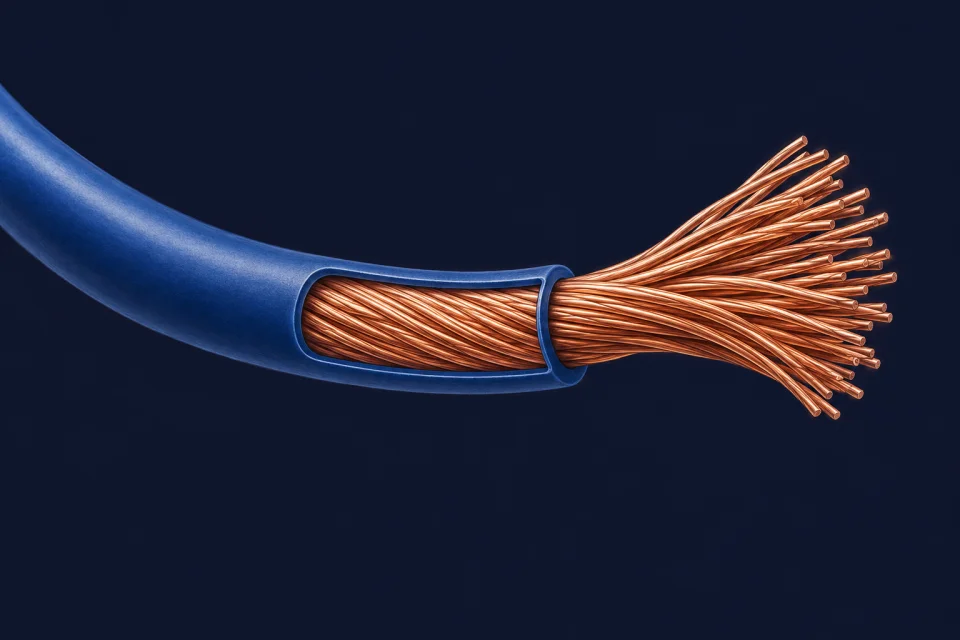
Outer insulationCopper conductor
The copper conductor carries current. Insulation separates it from its surroundings.Moving electrons carry electric current
Metals contain electrons that can move through the material. Applying a voltage gives their motion a net direction, producing current. Copper atoms do not stream from one end of a wire to the other.
The atom model shows the electron count of one atom in a simplified way. Explaining a wire also requires thinking about a large collection of atoms in a metal. A picture of one atom and a picture of a material answer different questions.
Copper: electrons can move
Schematic electron motion inside a metalAlloys give copper new uses
Brass is an alloy containing copper and zinc. Bronze commonly contains copper and tin. Combining metals can change properties such as hardness and how easily a material can be shaped.
A musical instrument, a fitting and an electrical contact need different properties. Asking why an element is chosen for a particular material can reveal more than simply memorizing where it is used.
Temperature and state
25°C: Solid
Illustrative particle motion: sizes, distances and speeds are not to scale. Particles represent atoms or molecules.
← CoolHeat →
Melting point 1,084.62°C / Boiling point 2,561.85°C
Pure element at 1 atmosphere. Image conditions are explained in captions. Pictures do not change with temperature.