Silicon occurs in quartz and many rocks as compounds.
The element connecting quartz and chips
Quartz is silicon dioxide, a compound of silicon and oxygen. Clear rock crystal is a form of quartz. Elemental silicon, however, is a gray solid, not a transparent quartz crystal.
Computer chips use highly purified silicon. A rock is not simply carved into a chip: obtaining and purifying the material, growing crystals and fabricating circuits are separate steps.
Silicon in rocks and chips
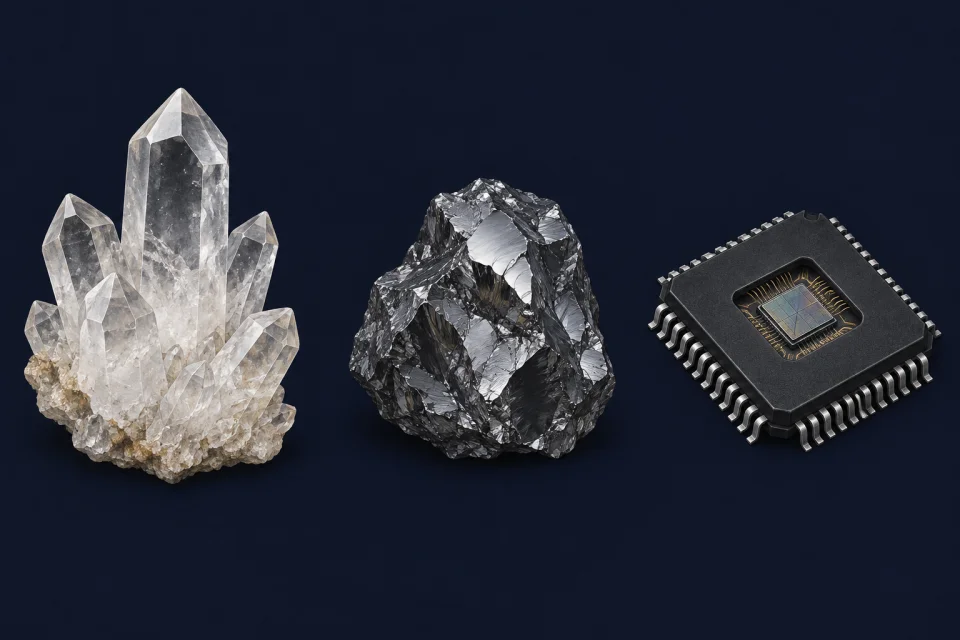
QuartzSiliconChip
Quartz is silicon dioxide, a compound. Highly purified silicon is used in semiconductor chips.Tiny additions change electrical behavior
Silicon is a semiconductor. Its electrical behavior depends on conditions such as temperature and the small amounts of other elements added to it. Adding carefully controlled amounts of boron or phosphorus changes its properties.
Combining regions with controlled properties helps make transistors, which control current. A chip contains many components and connections. A single silicon atom does not perform a calculation: the fabricated circuit does.
Raw material→Purified silicon→Crystal & circuit fabrication→Chip
Conceptual stages, not a manufacturing recipe.Sand, glass and silicon are different materials
Sand describes a collection of small grains, not one pure substance. Its minerals vary by location. Some sands contain abundant quartz, but not every sand is pure silicon dioxide.
Many glasses use silica as a major ingredient, along with other components. Their atomic arrangement is also different from a quartz crystal. Sharing an element or an ingredient does not make two materials identical.
Temperature and state
25°C: Solid
Illustrative particle motion: sizes, distances and speeds are not to scale. Particles represent atoms or molecules.
← CoolHeat →
Melting point 1,413.85°C / Boiling point 3,264.85°C
Pure element at 1 atmosphere. Image conditions are explained in captions. Pictures do not change with temperature.