Oxygen makes up about one fifth of the air.
Oxygen in air and oxygen in water
About one fifth of air is oxygen gas, usually consisting of O₂ molecules: pairs of oxygen atoms. In water, oxygen atoms combine with hydrogen in H₂O, a different substance.
Oxygen gas and water both contain oxygen, but they are not the same material. Oxygen combined with other elements also occurs in living things and rocks. Studying an invisible gas can connect us to familiar solids and liquids.
Containing oxygen is not the same as pure oxygen
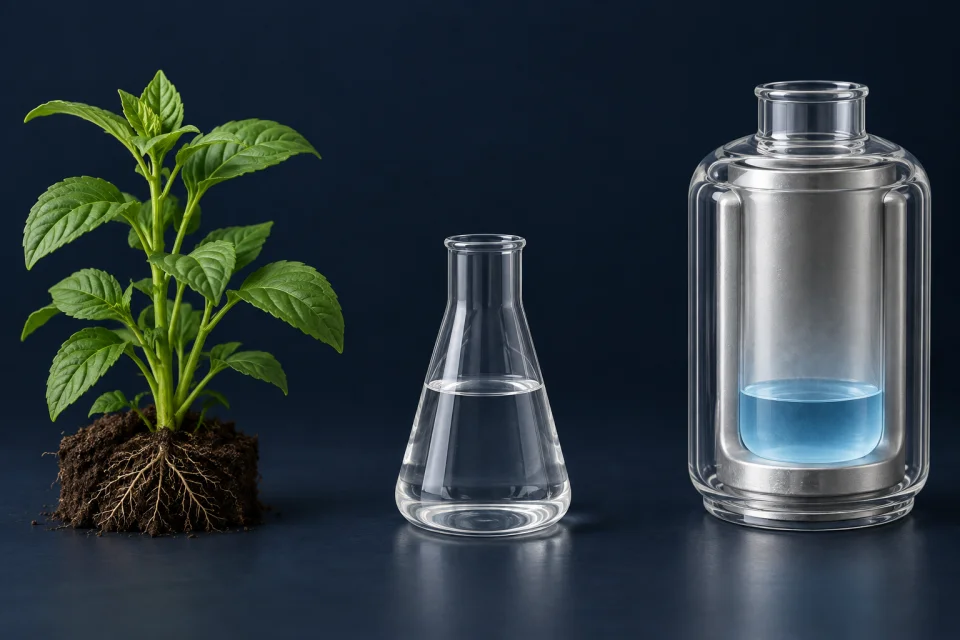
PlantWaterLiquid oxygen
In plants and water, oxygen is combined with other elements. Pure oxygen becomes a pale blue liquid when sufficiently cooled.A gas that supports burning
Oxygen participates in many burning reactions, but it is not the fuel in those reactions. Fuel reacts with oxygen or another oxidizing agent, producing new substances and releasing energy.
Distinguishing fuel, reaction partner and products helps make sense of combustion. When carbon reacts with oxygen to form carbon dioxide, the atoms have not vanished: their combination has changed.
Carbon+Oxygen→Carbon dioxide
C + O₂ → CO₂: atoms are rearranged, not lostCooling an invisible gas into a visible liquid
At room temperature oxygen is a colorless gas. Cooling it sufficiently produces a pale blue liquid. When discussing appearance, temperature and state matter. Illustrations here show representative views and do not change with the temperature control.
Liquid oxygen is different from oxygen dissolved in water. Aquatic organisms use dissolved oxygen. Becoming a liquid, dissolving in a liquid and becoming part of a water molecule are three different situations.
Temperature and state
25°C: Gas
Illustrative particle motion: sizes, distances and speeds are not to scale. Particles represent atoms or molecules.
← CoolHeat →
Melting point -218.79°C / Boiling point -182.95°C
Pure element at 1 atmosphere. Image conditions are explained in captions. Pictures do not change with temperature.