Iron is a major material in buildings and machines.
Iron and steel are not identical
Many objects called iron are actually made from steel or another iron-based alloy. Steel contains iron together with carbon and sometimes other elements. Pure iron and a finished steel product do not have identical properties.
Composition and heat treatment can change hardness and toughness. Maximum hardness is not always the goal: a bridge, a spring and a cutting tool need different combinations of properties.
Iron-containing materials differ
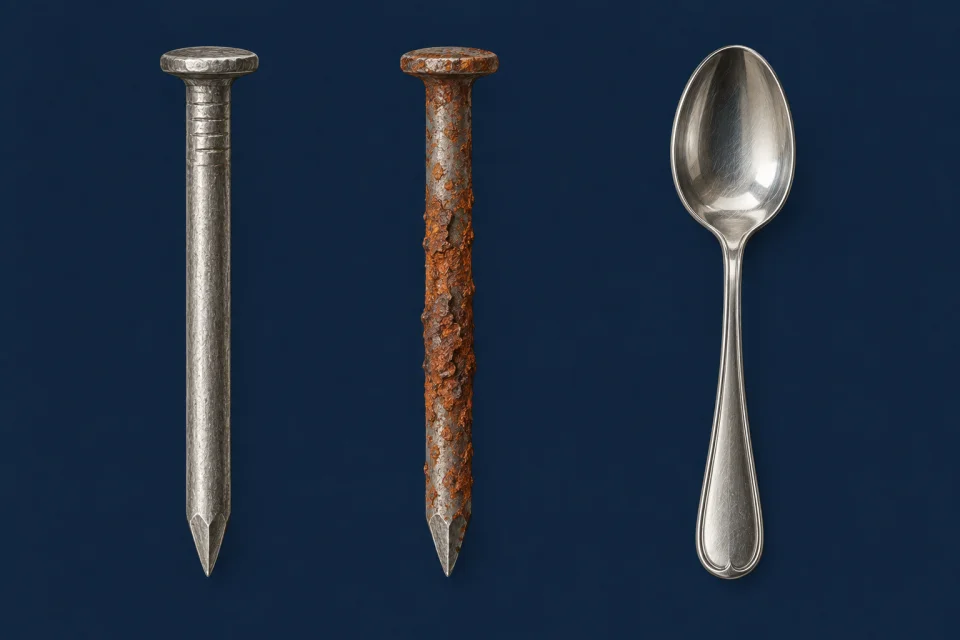
Iron nailRusty nailStainless steel
Rust forms when iron reacts. Stainless steel is an iron-based alloy containing chromium and other elements.What changes when iron rusts?
In damp air, iron can develop reddish-brown rust. This is not merely dirt on its surface: iron has undergone chemical reactions involving oxygen and water to form other substances.
Paint, metal coatings and alloy design can all help protect iron. In stainless steel, chromium helps create a thin protective surface layer. Stainless steel can still corrode under some conditions; its name does not make it immune to all reactions.
Iron+Oxygen & water→Rust: new substances
A chemical change, different from meltingSome early iron came from the sky
Obtaining iron from ore requires processes that change its chemical combinations. Some ancient objects instead used metallic iron from meteorites that had fallen to Earth.
Investigating elements such as nickel in an old iron object can help identify its origin. Analyzing materials can answer not only “what is this?” but also “where did it come from, and how was it made?”
Temperature and state
25°C: Solid
Illustrative particle motion: sizes, distances and speeds are not to scale. Particles represent atoms or molecules.
← CoolHeat →
Melting point 1,537.85°C / Boiling point 2,860.85°C
Pure element at 1 atmosphere. Image conditions are explained in captions. Pictures do not change with temperature.